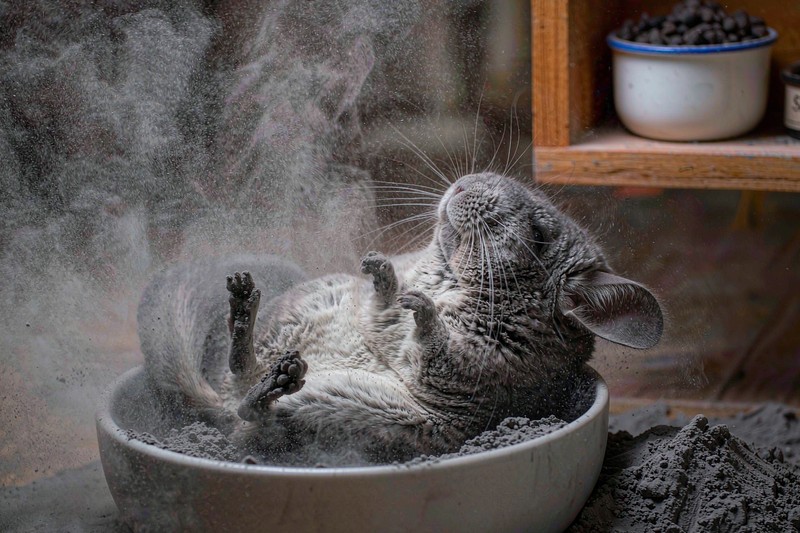
If you have never watched a chinchilla take a dust bath, you are missing the single best show in small-pet keeping: the flip, the shimmy, the explosive little cloud of volcanic dust. But dust bathing is not a cute enrichment activity — it is the only way a chinchilla can stay clean, and getting the details wrong damages the very coat you are trying to protect.
Why Chinchillas Can Never Get Wet
A chinchilla’s coat is the densest of any land mammal — roughly 80 hairs grow from a single follicle, where humans grow one. That density is why the fur feels like velvet, and it is also why water is dangerous: moisture gets trapped against the skin, cannot evaporate through all that hair, and becomes a breeding ground for bacterial and fungal infections. Chinchillas in the wild Andes never bathe in water. They roll in fine volcanic ash, which absorbs oils and debris from hair tip to skin.
So the rule is absolute: no water baths, ever. If your chinchilla gets wet accidentally, towel-dry gently, use a hair dryer on its lowest, coolest setting from a distance, and watch for any signs of skin trouble afterward.
The Right Dust and the Right Container
Not all dust is equal. Use a dedicated chinchilla bathing dust made of fine volcanic ash or sepiolite clay — the particles must be silky and fine enough to penetrate to the skin. Do not substitute:
- Play sand or builders sand — too coarse; scratches skin and eyes and cannot absorb oils.
- Cornstarch or talc — does not clean effectively and can promote bacterial growth.
- Dust sold for other small pets — often a different, unsuitable particle size.
For the container, think roll room: a heavy ceramic bowl, a glass fishbowl, or a commercial bath house, all stable and large enough for a full side-to-side roll. Fill with about two inches of dust. A chinchilla that can only dip its head is not actually bathing.
How Often, and for How Long
Here is where most owners go wrong in both directions. The working baseline is two to three sessions per week, 10 to 15 minutes each, then remove the bath from the cage. Adjust to your climate and your animal:
| Situation | Frequency | Why |
|---|---|---|
| Dry climate / winter heating | 2 times per week | Air is already dry; less oil buildup |
| Humid climate / summer | 3–4 times per week | Humidity makes coats clump faster |
| Coat looks dull or oily | Increase slightly | Oils are accumulating |
| Flaky skin, watery eyes | Reduce to once weekly | Sign of over-bathing |
Leaving the dust house in the cage permanently is the most common mistake — chinchillas will use it as a toilet, the dust picks up moisture and droppings, and the animal over-bathes until its skin dries out. Set a timer, remove the bath when it ends.
Hygiene, Reuse, and When to See a Vet
Dust can be reused for several sessions if you remove soiled or clumped material and store it in a sealed container. Discard it entirely when it clumps, darkens, or smells — contaminated dust can harbor fungal spores, which matters because ringworm is a common chinchilla problem. A chinchilla that suddenly stops using the bath, scratches constantly, or shows bald patches may have mites, ringworm, or dental pain, and needs an exotic vet rather than more dust. Get the rhythm right and the reward is real: that famously soft coat, kept clean the way nature designed — dust first, water never.