There are two ways to put food in front of a pet. You can leave a bowl out and top it up when it looks low, or you can measure a portion and serve it at set times. The choice looks like a matter of convenience. In practice it shapes body weight, behaviour, and how early you notice that something is wrong.
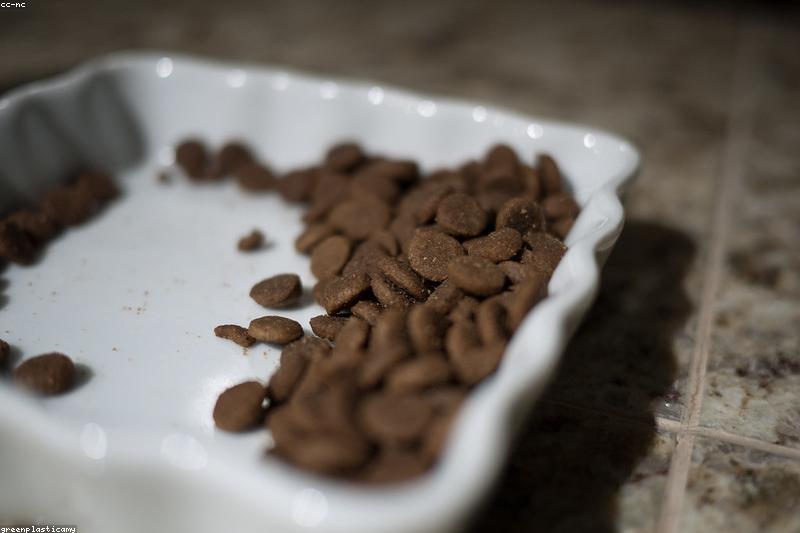
Veterinarians generally recommend measured meals, with monitored free feeding reserved for the minority of animals that genuinely self-regulate. Here is why, and how to change course if your household has been grazing for years.
What Free-Feeding Actually Changes
Free feeding, sometimes called free choice or ad libitum feeding, works only if the animal regulates its own intake. Some do. Many do not, and the reason is not greed. Appetite is a balance between hunger and fullness signals, and highly palatable, calorie-dense food activates reward pathways that can override the stop signal. Dry kibble is the food most often left out all day and also the most calorie dense per bite, so small amounts of overeating at each visit add up quietly.
Two structural problems follow from a bowl that is never empty. You cannot measure daily intake, so weight gain arrives before you notice the cause. And a constant supply removes any reason for the pet to work for food, which is the simplest form of enrichment a household has.
Appetite Is Health Data
A pet on measured meals tells you something every single day. A dog that leaves half a bowl, or a cat that walks away from a favourite meal, is reporting a change, and appetite loss is one of the earliest and least specific signs of illness.
With free feeding, that signal disappears. Food goes down and the bowl never empties at a predictable rate, so a partial loss of appetite can go unnoticed for days. The risk is highest in cats: a cat that stops eating for even a couple of days is at risk of hepatic lipidosis, a serious liver condition, which is exactly the situation where early detection matters most.
Dogs, Cats, and Different Defaults
Cats are often cast as natural grazers, and they do tend to prefer several small meals. That does not mean every cat can be trusted with an open bowl, particularly indoor, neutered, less active cats.
| Factor | Free-feeding | Scheduled meals |
|---|---|---|
| Calorie control | Hard; overeating is easy to miss | Precise and adjustable |
| Monitoring appetite | Poor; illness signs are delayed | Immediate; a skipped meal is obvious |
| Multi-pet households | Encourages competition and food guarding | Separate stations, individual portions |
| Enrichment | Low | High, using puzzles or training |
| Best fit | Some self-regulating cats, and young pets needing frequent intake | Most adult pets, and almost any pet with a medical condition |
When Scheduled Meals Are Not Optional
- Overweight pets. Portion control is the foundation of weight loss, and it is impossible without measurement.
- Diabetes. Insulin timing has to line up with food, so meals have to be predictable.
- Medication schedules. Many drugs are given with or without food at fixed intervals.
- Multi-pet homes. Separate rooms or times stop one pet eating another’s meal and reduce resource guarding.
- Rapid eaters. Measured meals plus a slow feeder reduce the gulping that leads to regurgitation.
- Any pet whose appetite you have been asked to track. If your vet wants a food diary, free feeding makes it impossible.
Cats that genuinely self-regulate at a healthy body condition can sometimes stay on free feeding, but the daily portion should still be measured out so that intake has a ceiling.
How to Switch Without a Hunger Strike
- Choose two fixed mealtimes for adult dogs and cats, and more frequent meals for puppies and kittens.
- Measure the daily ration and split it between the meals, keeping total calories the same as before.
- Put the food down for twenty to thirty minutes, then pick it up. Do not add treats to compensate.
- Expect a few days of adjustment. Most pets eat eagerly once the routine is predictable.
- Keep individual intake separate in multi-pet homes, and make sure the whole household uses the same portions.
- Use part of the ration in a puzzle feeder or snuffle mat, replacing the enrichment grazing used to provide.
- Track weight and body condition weekly for a month, then monthly.
A hybrid approach suits many cats: measured wet food meals at set times for moisture and portion control, with a little dry food delivered in a puzzle toy rather than left in a bowl.
Feeding style is not a moral question. It is a measurement question. If you can state how many calories your pet ate yesterday, you have what you need to manage weight, spot illness early, and adjust when life changes.