Guppies have a reputation as the easiest fish in the shop, and that reputation costs a lot of them their lives. They are genuinely hardy, but hardy is not the same as indifferent. Two things decide whether a guppy lives two years or two months: mineral-rich water, and a tank that does not swing. Here is how to set up both.
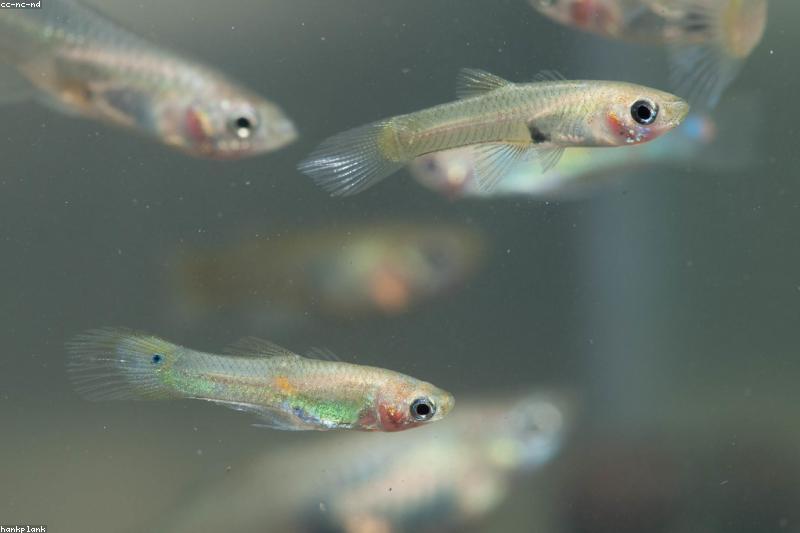
Guppies Are Hard-Water Fish, Not Just Beginner Fish
Guppies (Poecilia reticulata) come from mineral-rich waters in northern South America and the Caribbean, so they do best in water that is slightly hard and slightly alkaline. A general hardness (GH) of 8–12 dGH and a carbonate hardness (KH) of 4–8 dKH is the practical target.
GH is the number most new keepers ignore. Guppies need calcium and magnesium for fin development and sustained reproduction, and in long-term soft water keepers routinely see frayed fins, washed-out colour in males, and females that simply stop producing broods. If your tap water reads below 6 dGH, put a small bag of crushed coral or limestone in the filter, or remineralise at every water change. KH does a different job: it buffers pH. In a small, well-stocked tank, biological activity pushes pH down overnight, and 4 dKH or more stops that slide.
Tank Parameters at a Glance
| Parameter | Target | Why it matters |
|---|---|---|
| Temperature | 24–26 °C (75–79 °F) | 22–28 °C tolerated; below 18 °C appetite and immunity drop |
| pH | 7.0–7.6 | Extended time below 6.5 weakens fancy strains |
| GH | 8–12 dGH | Minerals for fins, colour and brood size |
| KH | 4–8 dKH | Buffers against overnight pH crashes |
| Ammonia and nitrite | 0 ppm | Even 0.25 ppm nitrite damages gills |
| Nitrate | Under 20 ppm | Chronic stress and fin rot above 40 ppm |
| Tank size | 10 gal minimum, 20 gal better | Larger volumes hold temperature and dilute waste |
Stability beats precision. A tank that sits at pH 7.4 all week is safer than one bouncing between 7.0 and 8.0.
Setup Choices That Protect Fins and Fry
- A long, low tank. Guppies swim mid-water horizontally and use length far more than height.
- Gentle filtration. A sponge filter, or a hang-on-back with a pre-filter sponge over the intake. Strong flow exhausts long fins and traps fry.
- A tight lid. Guppies jump, and a dried guppy on the floor is a common first-month loss.
- Plants. Java moss, hornwort and anubias give cover; floating plants give newborn fry somewhere to hide from adults.
- Darker substrate. Fine gravel or sand, 2–5 mm. Pale coarse gravel washes colour out and traps food.
- A reliable heater. An unheated room can swing several degrees overnight, and temperature swings are the usual trigger for ich.
Feeding, Fry, and the Livebearer Maths
Adults eat twice a day, and only what they clear in about two minutes. A quality micro pellet is the staple, supplemented two or three times a week with baby brine shrimp, daphnia or microworms. Fry under four weeks get four to five small meals a day. Overfeeding is the most common cause of water-quality trouble in guppy tanks, because uneaten food breaks down fast in warm water.
Guppies are livebearers: females drop free-swimming fry roughly every 25–30 days, and one female can store sperm and produce several broods without a male present. Keep at least two females per male, and three or more if you can, because males harass constantly and an outnumbered female will hide, stop feeding and lose condition. If you do not want a population explosion, keep males only; a small mixed colony can go from six fish to sixty in three months.
The Health Watchlist
Ich appears as white spots, usually after a temperature swing: raise the temperature gradually and use a proper treatment. Fin rot almost always traces back to water quality, so test before you medicate. Wasting and swim-bladder problems are often genetic in heavily line-bred fancy strains, which is one more reason to buy from a breeder who culls honestly.
Cycle the tank before any fish go in, change 25–30% of the water weekly with a gravel vacuum, and a guppy group will repay you with colour and fry for two to three years.