Sundown is shift change for your hamster. While you wind down, a healthy hamster is just clocking in: running, digging, foraging, hoarding food, and redecorating the bedding until shortly before dawn. Wild hamsters travel for kilometers every night, and a pet hamster on a wheel can cover the equivalent of several miles before sunrise. None of that is a behavior problem — it is the animal’s entire biology. The good news is that with a few deliberate choices, you can protect both your pet’s night shift and your own sleep.
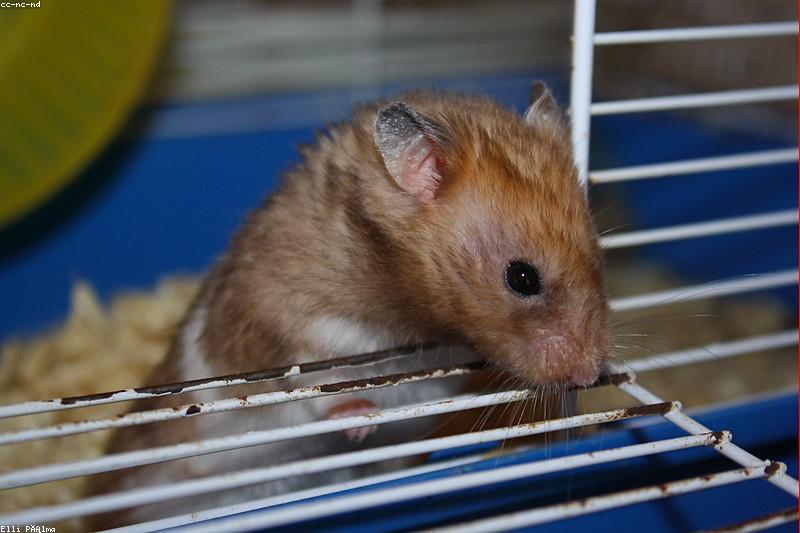
What Night Life Actually Looks Like
A settled hamster emerges around dusk, works in bursts rather than one continuous marathon, and returns to the nest before dawn. Rustling, digging, and the clatter of a wheel are the sounds of normal, healthy behavior. Wheel time varies a lot between individuals — Roborovskis are famous distance runners — so what matters most is your own hamster’s usual pattern, not some universal benchmark. Sudden changes in that pattern are the signal to pay attention, which we will come back to.
Set Up the Room, Not Just the Cage
Cage placement decides most of the night-noise problem before it starts:
- Keep the enclosure out of the bedroom. A dim, quiet corner of a living room or a separate room lets your hamster keep its natural schedule without scoring yours.
- Avoid daytime disturbance. The hamster sleeps most of the day, so pick a spot away from direct sunlight, radiators, draughts, and slamming doors.
- Mind ultrasonic noise. Hamsters hear frequencies you cannot; keep the cage away from televisions, monitors, and vacuum cleaners.
- Go deep on bedding. Deep bedding lets your hamster dig and tunnel, which replaces the most irritating night noise of all: bar chewing.
The Quiet-Night Hardware Checklist
| Item | What to choose | Why it matters |
|---|---|---|
| Wheel | Solid surface, no rungs or mesh, sized so the back stays flat | An arched spine means the wheel is too small and can cause injury |
| Wheel mounting | Own base, set into the bedding, on a dense mat | Stops vibration traveling into bars and furniture |
| Chew items | Untreated wood blocks, apple branches, cardboard tubes | Teeth never stop growing; quiet chewing beats loud bar gnawing |
| Hides | At least one or two enclosed hides | Security lowers stress and pacing |
Wipe the wheel axle during routine cleaning — but never oil it with cooking oil or household lubricants, because whatever touches the wheel ends up on your hamster’s coat and then in its mouth.
What Never to Do
- Never remove the wheel at night. That is a welfare problem, not a noise solution, and it usually produces bar chewing instead.
- Do not keep a light on to help the hamster “settle.” Light during active hours disrupts the rhythm rather than shifting it.
- Do not wake a hamster during the day to tire it out. It does not work, and being roused from deep sleep makes hamsters groggy, cranky, and more likely to bite.
- Do not cover the cage tightly to muffle sound. Airflow matters more than quiet, and a sealed cover can raise the temperature inside.
Instead, schedule handling and feeding for the late afternoon and evening, when your hamster wakes naturally, and give it a play session before your own bedtime so some energy is spent before you sleep.
When Night Changes Mean Something
The night schedule doubles as a health monitor. Call an exotics-savvy vet within the week if the wheel goes silent for several nights, the running becomes uneven or halting (which can mean a sore foot or a wheel that no longer fits), or bar chewing starts or intensifies in an enclosure that used to be fine. Go the same day if your hamster is limping or holding a foot up. And a hamster that is suddenly active in the afternoon and quiet at night may be disturbed by light, heat, or illness rather than “reversed.”
Living with a nocturnal pet is a negotiation, but a friendly one. Give your hamster a dark room, a proper wheel, deep bedding, and a predictable evening routine, and the night shift usually becomes white noise you barely hear — while your pet gets to live the life its body was built for.