Every bag of pet food prints a feeding chart, yet the recommended amounts vary widely between brands and rarely match what an individual animal actually burns in a day. Veterinarians work the problem the other way around: first estimate how many calories your dog or cat needs, then convert that number into grams of the specific food in your pantry. The math takes about five minutes, and it turns feeding from guesswork into a number you can measure and adjust.
Start With Resting Energy Requirement
The foundation is the resting energy requirement (RER): the calories a healthy pet burns at rest in a comfortable environment. The standard formula, used in the Merck Veterinary Manual and most veterinary nutrition references, is RER = 70 × body weight in kilograms raised to the 0.75 power. For pets over 2 kg and more than four months old, the simpler linear version (30 × kg + 70) gives a close estimate. Worked examples:
- A 4 kg cat: roughly 200 kcal per day at rest.
- A 10 kg dog: roughly 395 kcal per day at rest.
- A 25 kg dog: roughly 785 kcal per day at rest.
Note that the relationship is not linear: a 25 kg dog needs only about twice the resting calories of a 10 kg dog, not two and a half times. Larger dogs burn fewer calories per kilogram than small ones.
Multiply for Life Stage and Situation
RER is only the baseline. To get the daily maintenance target, multiply by a life-stage factor. Reference tables differ slightly between sources, so treat the numbers below as reasonable starting points rather than rules.
| Pet | Starting factor × RER |
|---|---|
| Dog, neutered adult | 1.6 |
| Dog, intact adult | 1.8 |
| Dog, prone to weight gain | 1.4 |
| Puppy under 4 months | 3.0 |
| Puppy 4 to 12 months | 2.0 |
| Cat, neutered adult | 1.2 |
| Cat, intact adult | 1.4 |
| Cat, indoor or weight-prone | 1.0 |
| Kitten | 2.0 to 2.5 |
So a 10 kg neutered adult dog starts at about 630 kcal per day, and a 4 kg neutered cat at roughly 240 kcal. Individual animals vary by 20 to 30 percent or more depending on activity, breed, temperature and metabolism, which is why the estimate must be checked against the scale.
Turn Calories Into Grams
Pet food labels state energy density as kcal per kilogram (and often kcal per cup). Converting the target into a portion takes four steps:
- Find the kcal per kg (or per 100 g) on the bag or can.
- Divide your daily calorie target by the kcal per gram to get grams per day.
- Split the grams across your pet’s meals.
- Weigh the portion on a kitchen scale.
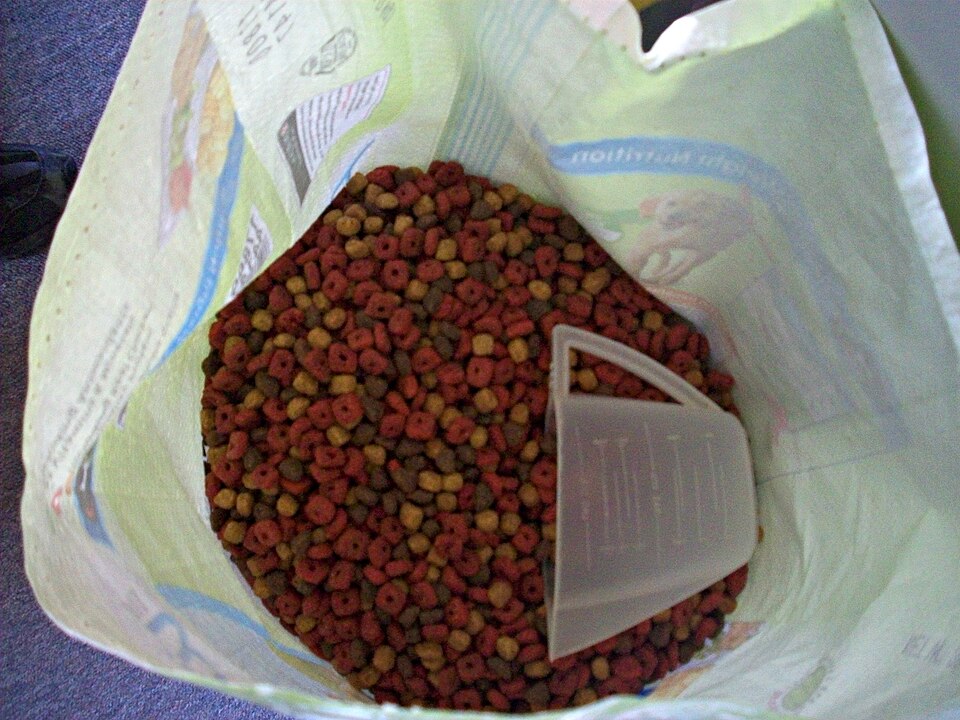
Measuring cups are the weak link: because kibble shapes and densities differ, a level cup of one food can carry far more calories than a level cup of another, and heaping adds more. Wet food needs the same treatment using its own kcal per can figure, since it is far less calorie-dense than kibble gram for gram. Treats, dental chews and toppers belong inside the daily total, not on top of it.
Recalculate as Your Pet Changes
The estimate is a snapshot. For an overweight pet, calculate from the target or ideal weight rather than the current one, and expect a supervised weight-loss plan to land near 1.0 × RER of that target weight — a job for your vet, since losing weight too fast is dangerous, especially for cats. Energy needs also drop after neutering, rise during growth, pregnancy and lactation, and change with illness. Weigh your pet every two weeks: if weight trends in the wrong direction for two consecutive checks, adjust the daily grams by about 10 percent and keep watching.
The formula is a starting point, not a verdict. Calorie math tells you where to begin; the body condition of the animal in front of you, tracked on a scale, tells you where to stay. Used together, they replace the vague scoop with a feeding plan you can actually defend.
Alisha Vargas / CC BY 2.0 / Wikimedia Commons