Walk down the small-pet aisle and you will see colorful starter cages that a Syrian hamster outgrows the day it arrives. Welfare-minded keepers long ago settled on a better answer: convert a large plastic storage bin into a bin cage. With a solid plastic floor, walls tall enough for deep bedding, and unbroken floor space that beats most pet-store cages, a finished bin costs about as much as a pizza night.
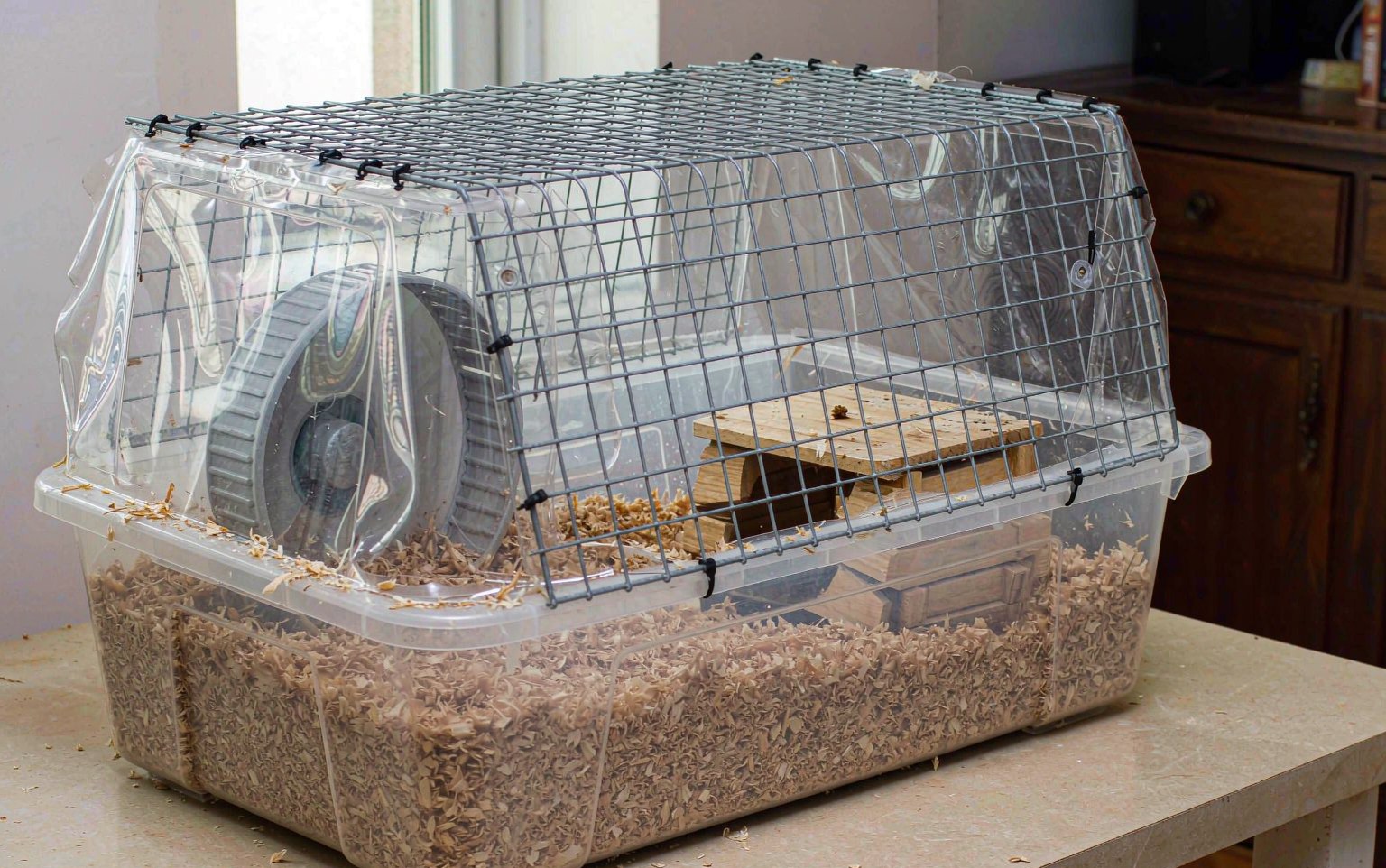
Why a Bin Beats the Pet Store Cage
Hamsters need unbroken floor space — commonly around 100 x 50 cm — far more than they need stacked levels and plastic tubes. Solid plastic walls hold 25 cm of bedding without spilling, the seamless floor is easy to spot-clean, and there are no wire bars to bend, rattle or chew. You can also size the enclosure to your room instead of to a catalog page, and the total price usually lands below thirty dollars. A clear bin gives you a full view of your hamster’s night shift without opening the lid.
The Shopping List
- A clear storage bin, 100–120 liters (about 200 quarts), with smooth interior walls
- Hardware cloth with roughly 6 mm (1/4 inch) spacing — never plastic mesh or window screen
- Heavy-duty zip ties, or bolts with washers for a cleaner finish
- Utility knife, drill, wire cutters and a marker
- A file or fine sandpaper for smoothing cut edges
Building It in Five Steps
- Mark two large rectangles on the lid, leaving a 4–5 cm border and a support strip between them.
- Cut the openings and smooth every cut edge with the file.
- Cut mesh panels with 2–3 cm of overlap and fold the raw wire edges over.
- Fix the mesh to the lid from below with zip ties or bolts, spaced every 4–5 cm.
- Do the nose test: run a finger around every edge and joint — any gap your finger catches, a hamster will find.
Ventilation is the step people underestimate. A few drilled holes are not enough, because ammonia from urine concentrates at bedding level inside a sealed box. Two large mesh panels create the cross-flow that keeps the air fresh and humidity down.
Setting Up the Inside
Fill the floor with 25–30 cm of paper-based bedding for a Syrian, or at least 15 cm for a dwarf, so real burrowing is possible. Add a solid-surface hamster wheel sized to your species — about 28 cm for dwarfs and 30 cm or more for Syrians — mounted so it clears the mesh lid when turning. A water bottle hangs neatly through the mesh; set the spout just above the bedding line. Scatter-feed the daily seed mix into the bedding for foraging, add two or three hides, and include a couple of safe wooden chew toys for tooth wear. A shallow dish of unscented sand gives your hamster a place to groom its coat — hamsters clean with sand, never with water. Keep the bin out of direct sun and away from radiators, because plastic holds heat.
Bottom line. A bin cage is only as safe as its build quality. Press-test the lid weekly, re-check for gaps after every deep clean, and your budget build will outperform almost anything on the pet store shelf.