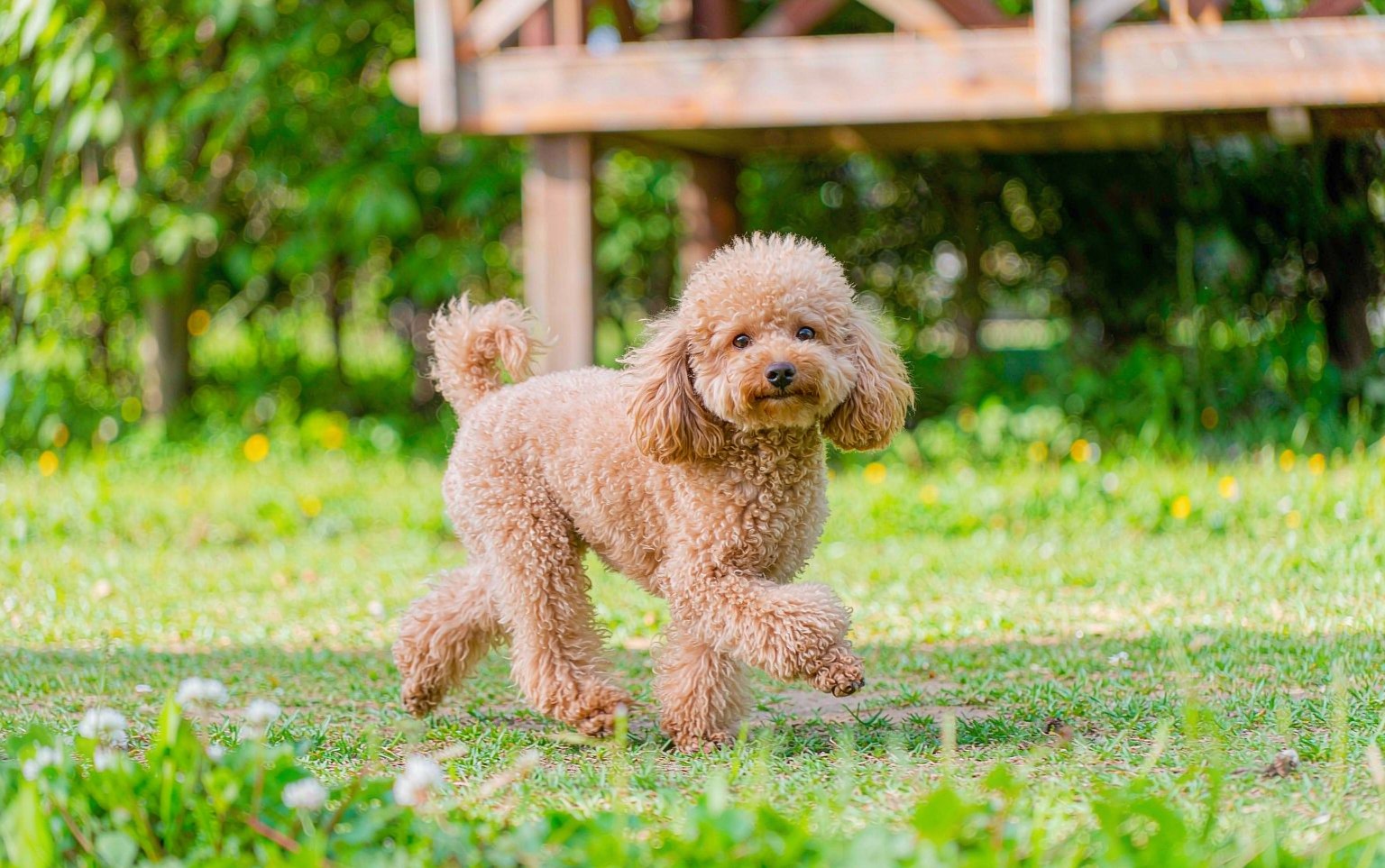
Small dogs have a signature quirk: they trot along, suddenly hold one hind leg off the ground for a few strides, kick it out, and then keep walking normally. Owners often film it because it looks almost comical. It is called a skipping gait, and the usual cause is a luxating patella, a kneecap that slides out of its groove. It is one of the most common orthopedic problems in toy and small breeds, and what to do about it depends entirely on how far it has progressed.
Why the kneecap slips
The patella normally glides up and down in a groove at the end of the femur, held in line by the muscles and ligaments of the hind leg. In many small dogs that anatomy is subtly off from birth: the groove is too shallow, the bones of the leg twist slightly, or the attachment point of the tendon sits too far to one side. The kneecap then pops toward the inside of the knee, which is called medial luxation. It is inherited, so affected dogs should not be bred, and signs usually appear between four and nine months of age in breeds such as toy poodles, Chihuahuas, Yorkshire terriers, Maltese, Pomeranians, and Cavalier King Charles spaniels. Left unmanaged, the constant friction wears cartilage, leads to arthritis, and strains the cruciate ligament inside the same knee, a much more serious injury.
The four grades
Vets grade the luxation by pushing the kneecap during an exam. The grade drives the plan.
| Grade | What it looks like | Usual direction |
|---|---|---|
| 1 | The kneecap can be pushed out manually but snaps straight back; the dog rarely limps | Monitor, manage weight, no surgery |
| 2 | The kneecap slips frequently on its own, causing the classic skipping gait and intermittent limping | Conservative care if mild; surgery if symptoms are frequent |
| 3 | The kneecap is out most of the time and can be pushed back only to pop out again | Surgery recommended |
| 4 | The kneecap is permanently out and cannot be repositioned; the dog walks crouched or cannot use the leg properly | Surgery, often with corrective bone cutting |
Conservative care or surgery
Grade 1 and some quiet Grade 2 dogs do well without surgery. The single most protective measure is keeping the dog lean, because every extra kilogram loads the knee. Beyond that: limit jumping on and off sofas, put rugs on slippery floors, build muscle with controlled walks and physiotherapy, and use anti-inflammatory medicine during flare-ups under veterinary guidance. Grades 2 with real symptoms through 4 are usually corrected surgically. The operations combine three ideas: deepening the groove so the kneecap has somewhere to sit, moving the tendon attachment so the pull is straight, and tightening or releasing soft tissue to balance the joint. Severely deformed legs may also need the bone itself realigned. In small breeds the outcome is generally excellent, with success rates around 90 percent and the kneecap slipping again in roughly 5 to 10 percent of cases.
Recovery and protecting the other knee
- Strict rest for about six to eight weeks after bony surgery, lead walks only, no jumping
- Physiotherapy and hydrotherapy rebuild the thigh muscle that stabilizes the knee
- Both knees are often affected, so the second side may need its own surgery later
- Keep the dog lean for life and watch for any return of the skipping gait
A skipping leg that self-corrects is not a reason to panic, but it is a reason to get the knee graded. Early planning, a lean body, and a non-slip floor do more for these knees than anything sold as a joint supplement.